
Airport Terminal Roofing in Richmond, VA
Roofing for Richmond International Airport and central Virginia aviation facilities, large low-slope terminal decks, jet-blast and wind exposure, badged crews, and 24/7 operational coordination.
Aviation roofing runs on the airport's clock, not ours
An airport never closes, and that single fact governs everything about roofing one. Richmond International Airport sits in Sandston in eastern Henrico County, serves central Virginia with carriers including American, Delta, Southwest, and United, and moves passengers and cargo around the clock. Every access point, every material lift, every crew deployment has to be coordinated with the airport's facilities department and its FAA Part 139 safety program, and on parts of the campus with TSA security protocols on top. We build that coordination into the scope before the contract is signed, not after a truck shows up at a gate. The airport's recent concourse and terminal investment, along with the broader logistics activity tied to the Port of Virginia and the military presence at Fort Gregg-Adams down the corridor, keeps real aviation roofing demand in this region, and the mid-Atlantic climate hits these roofs with both freeze-thaw cycling and humid-summer loading.
Richmond International is the hub, but it is not the only aviation property in the area. Central Virginia also has general aviation and reliever fields whose hangars and support buildings need the same understanding of the building type even where the security layer is lighter.
- Chesterfield County Airport (FCI), general aviation reliever southwest of the metro
- Hanover County Municipal Airport (OFP), general aviation field north of Richmond
Terminal roofs are large, flat, and unforgiving of standing water
The roof over a terminal is a different animal from a comparable-size warehouse. These are big, low-slope expanses with minimal pitch, which makes drainage design the whole ballgame, ponding tolerance on a terminal is effectively zero, because water that sits over a concourse full of travelers and sensitive systems is not a risk anyone accepts. We address that with tapered insulation built to move water decisively to the drains, and we treat the drainage layout as a primary design problem rather than an afterthought to the membrane selection.
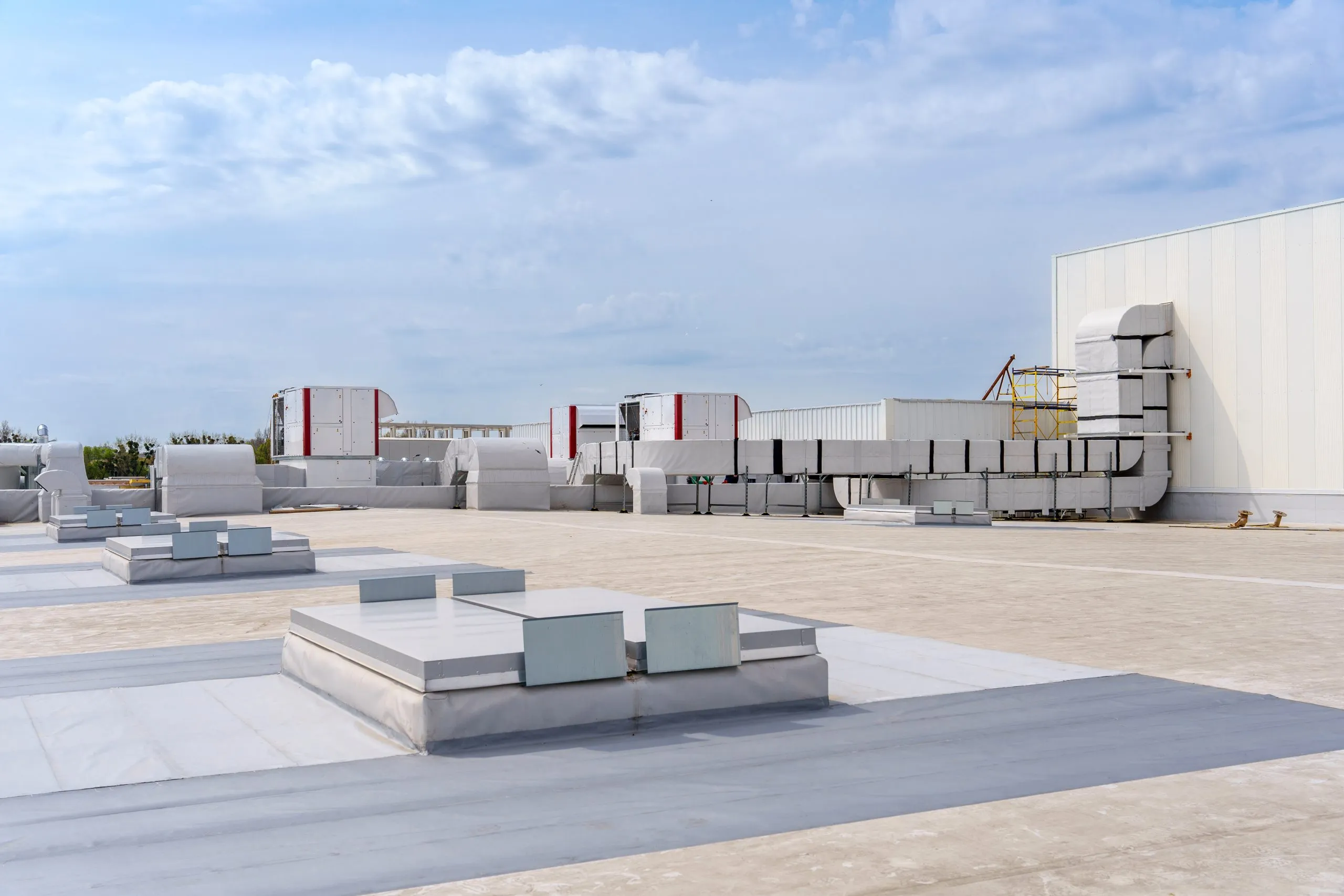
The mechanical density compounds it. Terminal HVAC is heavier and denser than standard commercial, which means a higher count of curbed penetrations and more flashing touchpoints that have to be maintained over time. Our pre-project survey documents every curb height, every penetration, and every mechanical clearance before we write the work plan, and oversized equipment curbs and complex through-penetrations get individually engineered flashing, never a generic pattern stretched to fit. The square footage matters too: a terminal roof is one of the largest single roof areas in a region, and on a deck that big, phasing becomes part of the spec. We break the work into zones that keep a watertight boundary against the live, occupied concourse below at every stage, so a reroof never exposes ticketing, baggage, or a gate hold room to the weather while travelers are under it. Daily dry-in on a 24/7 building is not a courtesy; it is the only acceptable way to leave the site each night.
Wind, jet blast, and high-bay hangars
Exposure on an airfield is more severe than at an inland commercial site. Airside roofs see jet blast and open-field wind that demand membrane adhesion and ballast or attachment specifications beyond what a sheltered logistics building would ever need. We specify for those uplift loads deliberately. High-bay hangars are their own structural problem: wide clear-span pre-engineered or wide-flange steel buildings with large roof planes that generate serious uplift, requiring specific fastening patterns and seam geometry, and on many of them standing-seam metal is the right answer rather than single-ply. We spec and install both across the region depending on the deck, the load capacity, and the operational constraints.
The campus is bigger than the terminal
Aviation roofing is not only the terminal building. Cargo facilities, rental-car centers, FBO buildings, aircraft maintenance hangars, and airport-campus hotels each present their own roofing demands, but the coordination requirement does not relax just because you have moved off the terminal. Badging and security access apply across the campus, and our crews treat that as a baseline, planned for in advance rather than discovered at a checkpoint. On the general aviation fields the security layer is lighter, but the buildings, high-bay hangars especially, are often the more demanding structures, and that is where the building-type expertise matters more than the clearance process.
- Phased work plans developed with airport facilities and the FAA Part 139 coordinator, including the NOTAM process where airside work requires it.
- Material deliveries and crane lifts scheduled into approved windows around live operations.
- Crew credentialing and airside authorization confirmed before mobilization, no exceptions for unbadged crew on airside work.
- Tapered drainage design treated as a primary scope element on large low-slope terminal decks.
- Individually engineered flashing for the dense, oversized mechanical curbs terminals carry.
Common questions on airport and aviation roofing
How do you schedule roofing at an operating airport like Richmond International?
We develop a phased plan with the airport facilities department and the FAA Part 139 coordinator, approved by airport operations. Deliveries, crane lifts, and any airside work go into approved windows and through the NOTAM process where required. This is standard project setup for us, not an exception.
What roof systems suit large-span terminal roofs?
Most terminal reroofing here uses TPO or PVC single-ply over a tapered insulation system built to improve drainage and eliminate ponding. New high-bay aviation structures and hangars often call for standing-seam metal. The choice follows the existing deck, load capacity, and operational constraints after we walk the roof with your facilities engineer.
How do you manage the density of HVAC penetrations on a terminal?
Terminal mechanical density is far above standard commercial. Our pre-project survey documents every penetration, curb height, and clearance before the work plan is written, and oversized curbs and complex penetrations get individually engineered flashing rather than a standard pattern.
Can you work airside, near active aprons and runways?
Yes, with appropriate badging and full coordination with airfield operations. Airside work takes more pre-planning and crew credentialing, which we build into the bid timeline. We do not mobilize crew without confirmed airside authorization.
Do you roof hangars for FBOs and general aviation?
Yes. General aviation hangar roofing, from a single-bay private hangar to a multi-unit FBO complex, is a regular part of our work. High-bay hangars with wide-flange or pre-engineered framing have specific uplift and thermal-movement characteristics, and we specify and install for them accordingly.
Talk to a Richmond commercial roofer
Tell us about the building and the issue. We will set up a roof walk and get you a clear, documented scope.