
Wind & Storm Damage Roof Insurance Claims in Richmond, VA
Documentation for wind and severe-thunderstorm roof damage on Richmond commercial buildings, built for the insurance claim rather than the repair invoice alone.
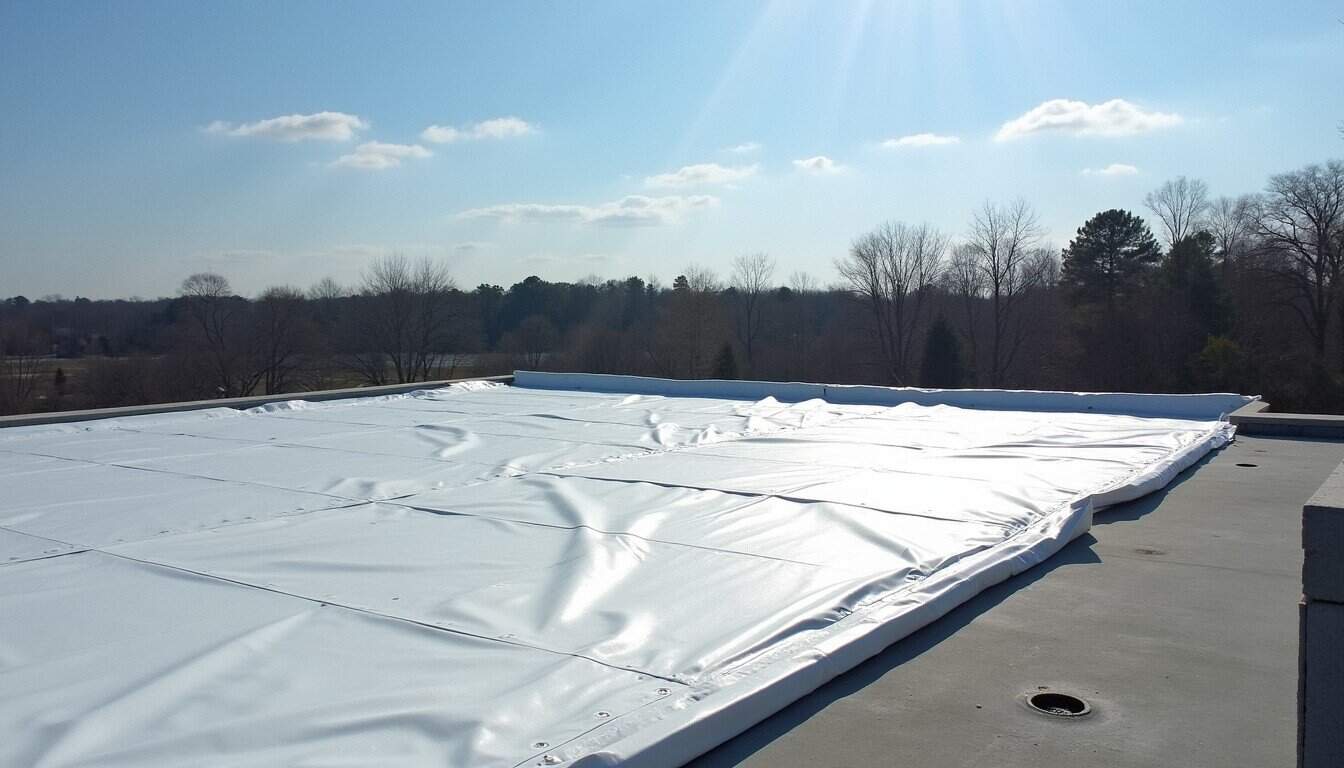
Richmond sits in a corridor that gets hit by fast-moving severe thunderstorm lines most summers, and every few years a derecho-type wind event or the remnants of a tropical system moving up the James River corridor push straight through the metro. None of that requires hurricane-force sustained wind to do real damage to a commercial roof. A single afternoon squall line with a short burst of high wind is often enough to lift edge metal, tear a seam, or drive debris through an aging membrane, and the roof can look fine from the parking lot the next morning.
How Wind Damage Actually Shows Up on a Low-Slope Roof
Wind rarely peels a commercial roof off in one dramatic piece. More often it works at the edges first: coping and edge metal that has started to separate at the fastener line, seams that have creased or opened under uplift pressure, and on ballasted systems, stone that has scoured away from one section and piled against a parapet on the downwind side. Rooftop units and curbs take their own kind of hit, with anchoring that has racked slightly or flashing that has pulled away enough to let wind-driven rain behind it. None of that shows up well in a photo taken from the ground, which is exactly why so many wind claims get underestimated before a roofer ever gets up there.
Derechos, Squall Lines, and Storm Remnants
Central Virginia's storm pattern comes from two sources: the summer severe-thunderstorm season that produces fast squall lines and occasional derecho-strength wind events, and the late-summer and fall systems that arrive as the weakened remnants of tropical storms and hurricanes tracking up the East Coast. Neither needs to be a named, landfalling hurricane to matter to a commercial roof. A squall line pushing through with a short burst of straight-line wind can do as much damage to loose edge metal or an already-aging membrane as a slower, wetter tropical remnant that sits over the region and tests every seam and drain on the roof.
Documenting Storm Damage Before It Gets Argued Away
Wind claims tend to get disputed more than any other roof claim type, mainly because wind damage is easier to explain away as ordinary wear if it is not documented quickly and specifically. We walk the roof as soon as it is safe, photograph the affected areas against undamaged sections for comparison, check fastening patterns at the perimeter, and note anything that points to a discrete wind event rather than gradual aging. If a local weather service report or a documented severe thunderstorm warning covers the date in question, we note that timing alongside our own findings so the file ties the damage to a specific event.
I-95 Corridor Warehouses and Large-Membrane Exposure
The distribution and logistics buildings strung along the I-95 corridor through Richmond carry some of the largest flat membrane fields in the metro, and a big flat field simply catches more wind load than a smaller roof with more perimeter relative to its area. Rooftop HVAC units, curbs, and skylights scattered across those fields each become a point where wind can find a way under the membrane. After a storm, we prioritize drainage first on these buildings, since a damaged drain or scupper combined with debris can turn a wind event into a standing-water problem within hours.
Converted Warehouse Roofs and Wind Exposure
Buildings that started life as tobacco warehouses and later became apartments, offices, or breweries in Scott's Addition and Manchester often have roof lines that were never designed as a single continuous field. Additions, mechanical penthouses, and rooftop patios sit at different heights and ages, and each transition between them is a place where wind can catch a lifted edge or drive rain sideways under flashing that was fine on the original structure but marginal on the addition. When we document wind damage on one of these buildings, we treat each roof section separately, since a claim written for one uniform roof age and system will not hold up when the adjuster sees three different roof generations on the same building.
We're your roofing contractor, not a public adjuster — we document and substantiate the roof damage so you and your adjuster work from an accurate scope.
Frequently Asked Questions
Does wind damage insurance cover a full roof replacement?
Sometimes. If the wind event compromised a small, isolated section, the file we build usually supports a repair. Widespread edge-metal failure, multiple seam separations, or exposed insulation across a large area point toward a replacement conversation instead.
How soon should we call after a storm?
As soon as it is safe to get someone on the roof. Wind damage is easier to tie to a specific storm date when it is documented within a day or two, before rain, debris, or foot traffic change what the roof looks like.
Can you tarp the roof the same day if there is active leaking?
Yes, emergency dry-in is usually the first call after a wind event with active water entry, and we handle that separately from the claim documentation itself so the building stops taking on water while the paperwork moves.
What if the adjuster says the damage looks like normal wear?
We document fastening patterns, seam condition, and damage location specifically enough to show whether the failure pattern matches a discrete wind event rather than gradual aging, and we bring that comparison to the roof walk.
Do large distribution roofs need a different inspection approach?
Yes. A roof that large gets walked in sections with attention to drainage first, since debris and damaged drains after a storm can create standing water faster than the wind damage itself needs repair.
Talk to a Richmond commercial roofer
Tell us about the building and the issue. We will set up a roof walk and get you a clear, documented scope.